


Vertex connectivity and edge connectivity
To determine the vertex connectivity of a graph, we ask the question: what is the minimum number of vertices that we must remove from the graph to disconnect it?
Since, by definition, an edge connects two vertices, when a vertex is removed from a graph, all of the edges incident with that vertex must also be removed. These edges cannot be arbitrarily connected to other vertices.
This graph has vertex connectivity of 1:

This graph has vertex connectivity of 3:
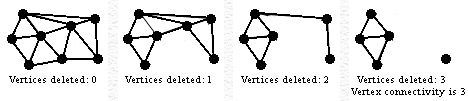
This graph has vertex connectivity 5:
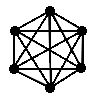
You cannot split a complete graph into two disconnected components by simply removing vertices. Removing successive vertices ultimately reduces the graph to a single vertex. So for complete graphs, the connectivity is measured by counting the number of vertices that must be removed to reduce the graph to a single vertex.
To determine the edge connectivity of graph, we ask the question, what is the minimum number of edges that we can remove from the graph to disconnect it?
| This graph has edge connectivity of 1: |  |
| This graph has edge connectivity of 2: |  |
| This graph has edge connectivity of 3: |  |
Notice that deleting an edge from a graph does not require you to delete any vertex in the way that deleting a vertex requires you to also delete the incident edges.
Copyright © 1999-2000 SciMathMN